

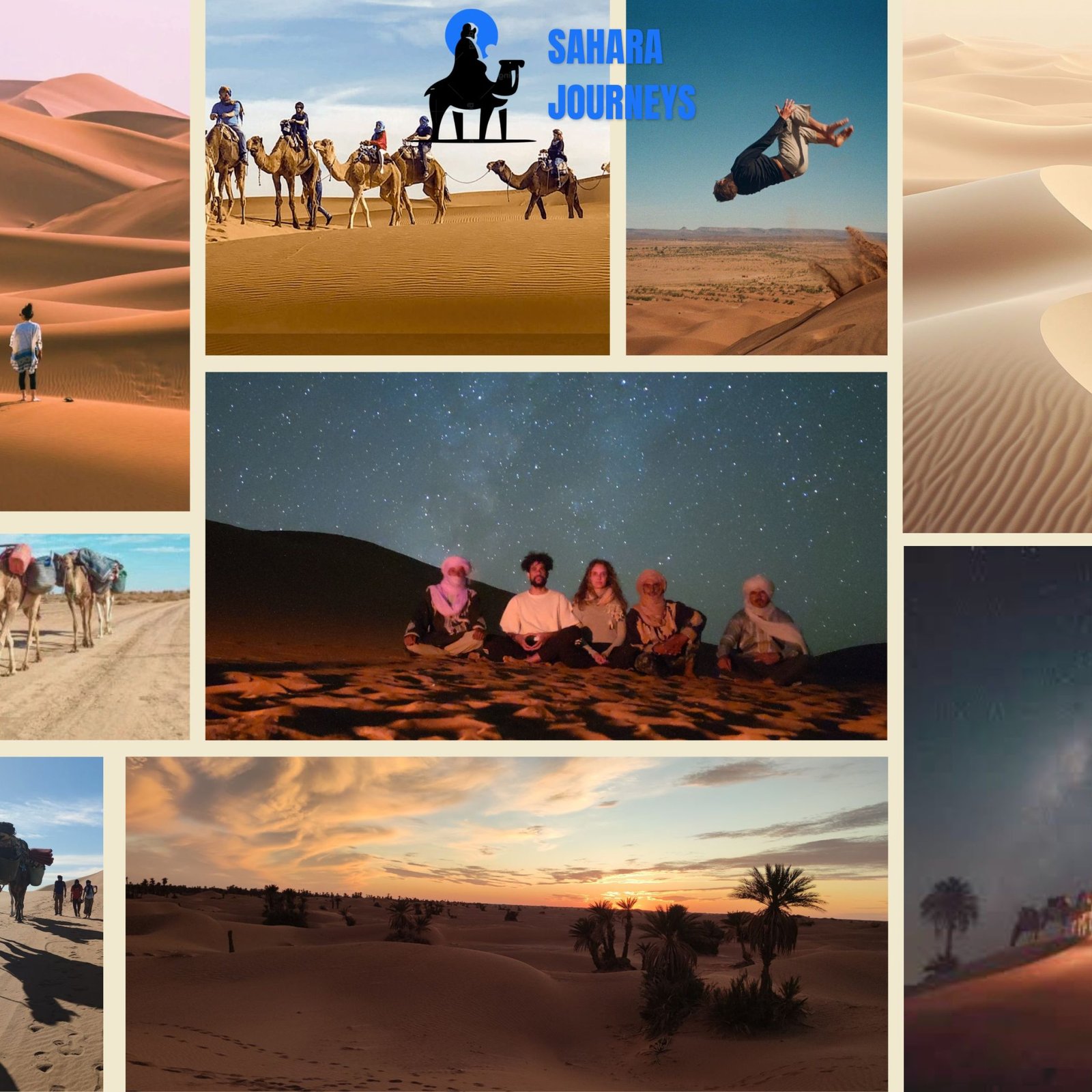

Venturing into the Moroccan Sahara is often the centerpiece of a North African journey. While many imagine riding atop a camel, true desert trekking—especially when seeking an authentic, immersive experience—is done on foot. In this traditional style of travel, the camels act as the vital support crew, carrying the baggage, tents, water, and food while you walk alongside them.
For those looking to escape the crowded tourist trails, the remote reaches of Erg Chigaga offer a far more raw and untouched landscape than the easily accessible dunes of Erg Chebbi. Accessible via the village of M’hamid El Ghizlane, Erg Chigaga provides the profound stillness and vastness that desert purists seek.
Here is a professional, detailed guide on what to realistically expect from a genuine desert trek.
1. The Physicality of the Trek
Walking in the desert is a unique physical endeavor. The terrain shifts constantly from hard-packed rocky plains (hamada) to soft, rolling sand dunes.
- The Pace: The rhythm of the caravan is dictated by the camels and the landscape. It is not a race; it is a slow, steady, and meditative walk. Expect to cover anywhere from 10 to 20 kilometers a day, depending on the itinerary.
- Muscular Fatigue: Walking in soft sand engages the calves and ankles much more than standard hiking. It takes a couple of days for your body to adjust to the shifting ground.
- The Environment: The vastness can be mentally challenging as much as physically. Distances are deceptive in the desert, and a dune that looks close may take an hour to reach.
2. The Desert Timeline
A typical trekking day follows a specific rhythm dictated by the sun and the heat.
- The Morning Wake-up: Expect an early start, often around 5:00 AM or 6:00 AM, to witness the sunrise over the dunes and pack up camp before the heat sets in.
- The Walk: Most of the walking is done in the morning. After a traditional lunch prepared by the team and a long siesta in the shade to escape the midday sun, the trek continues for a couple of hours in the late afternoon.
- The Arrival: You will typically reach the wild camp site as dusk falls, helping to set up the bivouac.
- The Evening: Expect a traditional Tagine or couscous dinner cooked over the fire, followed by traditional music and drumming under an impossibly clear canopy of stars.
3. Essential Packing List
The desert environment is a land of extremes. Preparation is the difference between a transformative experience and a grueling one. Here is the definitive list of what to bring:
Individual Equipment
- Clothing: * Lightweight, non-synthetic long-sleeved shirts or t-shirts for walking (protects from sun).
- Lightweight hiking trousers.
- Fleece jacket and waterproof jacket (highly recommended for December to February).
- Warm hat, gloves, tights, and a heavy jacket (essential for the cold nights in January).
- Several pairs of socks.
- Note: Taking a stage barefoot or in socks is entirely possible and highly enjoyable if your feet are sore!
- The Essential “Cheche”: A long cotton scarf to protect your head, neck, and face from heat, cold, wind, and sand. You can purchase one directly in M’hamid for about 50 to 75 MAD ($5 to $7 USD) depending on the length.
- Gear: * Headlamp (with extra batteries).
- A large water bottle or canteen (1.5 L).
- Walking poles (strongly recommended for longer treks).
- A waterproof pouch for important documents (keeps fine sand out).
- Binoculars (optional but great for wildlife and vast views).
- Swimming goggles or ski goggles (optional, but a lifesaver for sensitive eyes in case of a sandstorm).
- Pocket games or books, especially if traveling with children.
- Footwear: A pair of shoes specifically for desert walking, such as open sports sandals used with a pair of socks. Heavy, rigid mountain boots are not suitable for walking in the soft sand.
- Sleeping & Hygiene:
- Sleeping Bag: * Comfort 10°C to 15°C for October, March, and April.
- Comfort 5°C to 10°C for November and February.
- Comfort 0°C to 5°C for December and January.
- Note on Sheets: Water is the rarest commodity in the village of M’hamid El Ghizlane, and the supply network does not function perfectly year-round. To preserve this vital resource, sheets are not provided, and trekkers must bring their own sleeping bags.
- Toilet paper and a lighter. Crucial: Do not bury toilet paper in the sand or under a stone. You must burn it on the spot to maintain the purity of the desert.
- Towel (for both the fixed camp and the mobile trek).
- Return clothes (keep these isolated and clean, ideally left behind at the fixed base camp to wear after the trek).
- Sleeping Bag: * Comfort 10°C to 15°C for October, March, and April.
The Desert Medical & Hygiene Kit
- Care Items: Small bandages, anti-blister pads (moleskin), tweezers, and antiseptic.
- Water & Hydration: To minimize plastic impact, we provide mineral water from large 5L containers to refill your bottles. We strongly invite trekkers to bring a filtering water bottle (like Lifestraw). These or water purification tablets (like Micropur) are mandatory for long treks exceeding 7 days.
- Dry Hygiene: Since water is scarce, plan for waterless washing: wet wipes, no-rinse lotion (alcohol-free), sunscreen, and eye/nose rinse solution. A horsehair glove is great for dry scrubbing (you can enjoy a traditional hammam back in the village at the end of the trek).
- Classic Medication: Painkillers, anti-inflammatories, anti-nausea, anti-diarrhea, antispasmodics, and rehydration salts.
- The Natural Kit Alternative: * Compact Oregano Essential Oil (strong antibacterial).
- Peppermint Essential Oil (for headaches and motion sickness).
- Italian Helichrysum Essential Oil and Ginger Essential Oil (gentle laxative).
- Propolis capsules (antibacterial) and propolis solution (for wounds and blisters).
- Senna-based complex or blond psyllium (to regulate transit).
- Activated charcoal (for intestinal issues).
[Check some of Our treks in the desert]
4. Cultural Etiquette and Interaction
The cameleers and guides (often of Berber or Sahrawi descent) are the heartbeat of the experience. Many have grown up in these dunes and possess an encyclopedic knowledge of the terrain.
- Communication: Many guides speak a mix of Darija, Berber, French, and English. Learning a few words of Arabic (like Shukran for “Thank you”) goes a long way.
- Animal Welfare: Respect the animals. While camels are incredibly hardy, they are the lifeline of the desert nomads. Treat them with respect as they carry your camp from site to site.
- Tipping: It is customary to tip your guide and cameleers at the end of the trek. This is a standard and highly appreciated practice in Moroccan hospitality.
5. Environmental Realities
The Sahara is beautiful, but it is an unforgiving environment that requires conscious respect from its visitors.
- Connectivity: Do not expect cellular service once you move deep into the ergs. Treat this as a digital detox.
- Sand Management: Sand will get into everything—your pockets, your shoes, and especially your camera lenses. Keep all electronics in sealed dry bags or Ziploc bags when not in use.
- Silence: Perhaps the most unexpected part of the journey is the absolute silence. Away from the hum of engines and city life, the desert offers a level of quiet that can be deeply moving.
Trekking through Erg Chigaga is not a high-speed adventure or a passive ride; it is a slow-motion immersion into one of the most storied landscapes on Earth. By embracing the rhythm of the walking caravan and respecting the delicate environment, you ensure an authentic, unforgettable Saharan journey.
[Check some of Our treks in the desert]
Would you like me to help you format this specific call-to-action text into actual HTML code or a shortcode that you can easily paste directly into your WordPress block editor?
0 Comment