

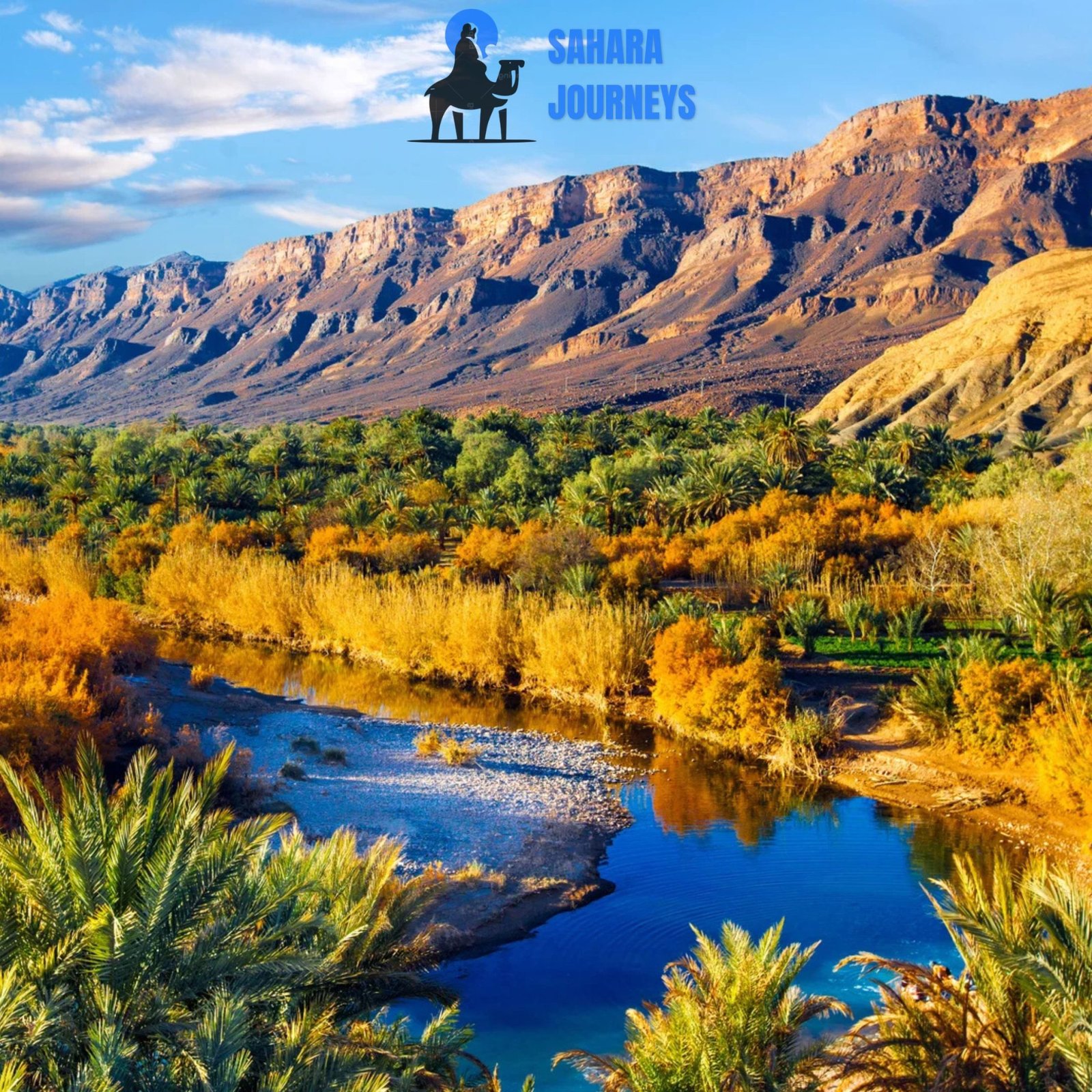

Spanning over 200 kilometers from the High Atlas Mountains to the edge of the Sahara, the Draa Valley is one of Morocco’s most dramatic and historically significant landscapes. It is a ribbon of deep green palms cutting through a scorched, lunar-like desert—a testament to the resilience of nature and the ancient Saharan caravan routes.
At SAHARA JOURNEYS, the Draa Valley is more than just a destination; it is our home and the starting point for our pedestrian treks. To walk through the Draa is to walk through centuries of history, where the rhythm of life is still dictated by the flow of water and the shade of the date palm.
1. The Geography: A Tale of Two Landscapes
The Draa Valley is a geological marvel that showcases the stark contrast between the “Hamada” (stony desert plateaus) and the “Oasis” (fertile riverbeds).
- The River Draa: Morocco’s longest river, the Draa, originates in the Atlas Mountains. While much of its water is now managed by the El Mansour Eddahbi dam near Ouarzazate, the underground water table continues to nourish the massive palm groves that line its banks.
- The Saghro and the Atlas: To the north, the valley is framed by the rugged peaks of the Anti-Atlas. As you travel south toward M’hamid El Ghizlane, the mountains flatten into vast, open plains, signaling the true beginning of the Saharan territory.
- The Six Oases: The valley is composed of a string of six distinct oases: Mezguita, Tanzouline, Ternata, Fezouata, Ktaoua, and M’hamid. Each has its own unique character, fortified villages, and micro-climate.
2. The Great Draa Oasis: A Vertical Forest
The Draa Oasis is not just a collection of trees; it is a sophisticated “three-story” agricultural system that has sustained local populations for millennia.
The Three Layers of the Oasis:
- The Canopy: Date palms (Phoenix dactylifera) provide the essential “umbrella,” shielding the ground from the blistering sun and reducing evaporation.
- The Orchard: Under the palms, fruit trees like pomegranates, figs, almonds, and apricots thrive in the filtered light.
- The Garden: At the ground level, farmers grow alfalfa for livestock, as well as henna, barley, and vegetables (carrots, onions, turnips).
The Role of the Seguias
Water management is a communal art in the Draa. An intricate network of open-air channels called seguias distributes water from the river or wells to each garden. The distribution is strictly timed, a tradition managed by the “Master of Water” in each village to ensure every family receives their fair share.
3. The Architecture of Clay: Kasbahs and Ksours
The landscape of the Draa Valley is punctuated by towering structures made of pisé (rammed earth). These buildings seem to grow directly out of the soil.
- Kasbahs: These are fortified residences, often built for a single powerful family or local governor. They feature high walls and four corner towers, designed for both defense and to stay cool in the summer heat.
- Ksours (plural of Ksar): These are entire fortified villages. A Ksar is a collective living space where many families live within protective walls, sharing communal areas, mosques, and granaries.
- The Color of the Draa: Because they are made of earth, these structures eventually crumble back into the ground if not maintained, creating a beautiful, cyclical landscape of ruins and restored palaces.
4. Cultural Heritage: The Gateway to Timbuktu
For centuries, the Draa Valley was the final “green” stop for trans-Saharan trade caravans. It took 52 days to reach Timbuktu from the southern end of the valley, and this history has left a profound mark on the local culture.
| Element | Significance in the Draa |
| Ethnic Diversity | A melting pot of Berbers (Amazigh), Arabs, and Haratines, creating a rich tapestry of music, dance, and dialects. |
| Tamegroute Pottery | Located near Zagora, this village is famous for its unique green-glazed pottery and its ancient Sufi library housing thousands of medieval manuscripts. |
| Traditional Crafts | The valley is renowned for indigo dyeing, silver jewelry, and the weaving of palm-leaf baskets. |
5. Trekking Through the Draa with Sahara Journeys
While many travelers see the Draa from a car window, the only way to truly experience its soul is on foot. Our treks often follow the ancient paths through the palm groves and along the riverbeds.
- The Pedestrian Pace: Walking allows you to notice the small details—the sound of the wind in the palms, the scent of blossoming henna, and the hospitality of farmers who often invite travelers for tea.
- The Logistics: Our camels carry all the heavy equipment (tents, food, water), leaving you free to walk with just a light daypack. This allows us to reach remote areas of the oasis and hidden kasbahs where vehicles cannot pass.
- The Seasonal Rhythm: The best time to trek the Draa is between October and April. In the autumn, you can witness the date harvest, while spring brings the vibrant green of the new crops.
[Check some of Our treks in the desert]
6. Environmental Challenges and Conservation
The Draa Valley is a fragile ecosystem facing modern challenges. Climate change and prolonged droughts have put immense pressure on the water table.
- Date Palm Preservation: The “Bayoud” disease and water scarcity have threatened the palms. At SAHARA JOURNEYS, we advocate for responsible tourism that respects water limits and supports local oasis economies.
- Sustainable Tourism: By choosing a walking trek, you minimize your carbon footprint and ensure that the financial benefits of your trip go directly to the local guides, cooks, and cameleers who call this valley home.
- Waste Management: As per our protocol, we leave no trace. We carry out all non-biodegradable waste and use traditional cooking methods that do not deplete the local vegetation.
The Draa Valley is a bridge between the high mountains and the infinite sands. It is a place of profound beauty, deep history, and enduring spirit. Whether you are exploring the narrow alleys of an ancient Ksar or walking under the shade of a thousand palms, the Draa will leave an indelible mark on your heart.
[Check some of Our treks in the desert]
0 Comment